


Going to the dentist can feel overwhelming when you have dental phobia. Many adults in Blaine avoid needed dental care because of fear or anxiety about procedures.
The good news is that modern dental practices offer several ways to help you feel calm and comfortable during treatment.
Sedation dentistry uses medication to help you relax during dental procedures, with options ranging from mild sedation that keeps you awake to deeper sedation where you may not remember the appointment.
Your dentist can work with you to pick the right level based on your anxiety, your oral health needs, and the type of procedure you need.
Understanding your choices makes it easier to get the dental care you deserve.
When you know what each sedation option involves, you can have an honest conversation with your dentist about which approach fits your situation best.
Key Takeaways
- Adults with dental phobia can choose from several sedation levels to help manage dental anxiety during treatment
- Options include nitrous oxide, oral sedation pills, IV sedation, and general anesthesia depending on your comfort needs
- Blaine dentists offer sedation services that let you receive necessary care without fear
Table of Content
- Understanding Dental Anxiety and Phobia
- Overview of Sedation Dentistry
- Comparing Sedation Options for Adults
- Benefits and Considerations of Each Sedation Type
- Finding Sedation Dentistry in Blaine
- Frequently Asked Questions
Understanding Dental Anxiety and Phobia
Dental fear exists on a spectrum from mild nervousness to severe phobia that prevents any dental care.
About 30-40% of people experience some level of dental anxiety, while roughly 10% deal with extreme dental phobia that keeps them from getting necessary treatment.

Common Causes of Dental Fear
Past negative experiences at the dentist rank as one of the top triggers for dental anxiety. If you had a painful procedure as a child or felt dismissed by a provider, those memories can create lasting fear.
The clinical environment itself causes stress for many patients. The sounds of drills, the smell of antiseptic, and the sight of needles can all trigger your fight-or-flight response even before treatment begins.
Loss of control also plays a major role in your anxiety. When you’re reclined in the dental chair with instruments in your mouth, you can’t easily communicate or leave.
This vulnerable position makes many people feel trapped or helpless.
Some patients develop dental fear from hearing scary stories from friends or family members. Others struggle with general anxiety that extends to medical and dental settings.
Fear of judgment about the condition of your teeth can also keep you from seeking regular oral healthcare.
How Dental Anxiety Affects Oral Health
Avoiding the dentist because of fear creates a harmful cycle. When you skip regular cleanings and checkups, small problems like cavities or gum disease go unnoticed and grow worse.
Delayed treatment often means you need more complex and expensive procedures later. A simple filling might turn into a root canal or extraction if left untreated for years.
This creates more anxiety about cost and the procedure itself.
Your overall health suffers when dental problems go untreated. Gum disease links to heart disease, diabetes complications, and other serious conditions.
Tooth pain and infection can also affect your ability to eat, sleep, and focus on daily activities.
Recognizing Signs of Odontophobia
Odontophobia means clinical-level dental phobia that goes beyond normal nervousness.
You might have this condition if you experience panic attacks when thinking about dental appointments or cancel multiple appointments due to fear.
Physical symptoms include rapid heartbeat, sweating, difficulty breathing, nausea, or dizziness when you enter a dental office. Some people cry, shake, or feel an overwhelming urge to flee.
Behavioral signs include avoiding dental care for years despite tooth pain or visible problems. You might also experience dental anxiety that leads to complete avoidance of any discussion about oral health.
If your fear interferes with your daily life or causes you to neglect serious dental issues, professional help can make a real difference.
Overview of Sedation Dentistry
Sedation dentistry uses medication to help you relax during dental procedures, making it possible to receive care even if fear has kept you away from the dentist for years.
Different levels of sedation are available depending on your anxiety level and the complexity of your treatment.
What Is Sedation Dentistry?
Sedation dentistry involves using medication to help patients relax during dental procedures. It offers an effective solution for individuals who experience dental phobia, fear, or anxiety.
The medication doesn’t eliminate all sensation, but it reduces your awareness and helps you feel calm. You can receive sedation for routine cleanings or complex procedures.
Sedation is grouped by depth: minimal, moderate, deep, and general anesthesia. Minimal sedation keeps you awake but relaxed. Moderate sedation may make you drowsy and less aware of your surroundings.
Deep sedation puts you on the edge of consciousness, and general anesthesia makes you completely unconscious.
The deeper the sedation level, the more training and monitoring your provider needs to keep you safe throughout your appointment.
Who Should Consider Sedation Options?
You should consider sedation options if dental anxiety prevents you from getting the care you need. Nearly 30-40% of people experience some form of dental fear, with around 10% suffering from extreme dental phobia.
Managing dental anxiety through sedation makes sense if you have had traumatic dental experiences in the past, fear needles or dental instruments, have a strong gag reflex, or need multiple procedures in one visit.
It’s also helpful if you struggle to sit still for long appointments or have sensitive teeth.
Children who cannot cooperate during treatment and adults with special needs often benefit from sedation. Your medical history matters too—certain conditions require specialist evaluation before sedation.
Roles of Sedation Dentists and Specialists
Many general dentists in Blaine offer basic sedation options like nitrous oxide and oral sedation pills. These methods work well for mild to moderate anxiety during standard procedures.
Deeper sedation usually requires a dental anesthesiologist, an oral surgeon, or a physician anesthesiologist with dental training.
A dental anesthesiologist completes a multi-year hospital-based residency in anesthesia after dental school, focusing on managing sedation for dental patients across all risk levels.
Your sedation dentist will review your medical history, current medications, and past reactions to anesthesia before recommending an option.
They’ll monitor your vital signs throughout the procedure to ensure your safety.
If you have significant medical conditions like severe heart or lung disease, sleep apnea, or prior bad reactions to sedation, you should ask for specialist care.
An oral surgeon or dental anesthesiologist has the advanced training needed to handle complex cases safely.
Comparing Sedation Options for Adults
Adults with dental phobia can choose from several sedation options based on anxiety level, medical history, and the complexity of your dental work.
Each method offers different levels of relaxation, from mild calming effects to complete unconsciousness.
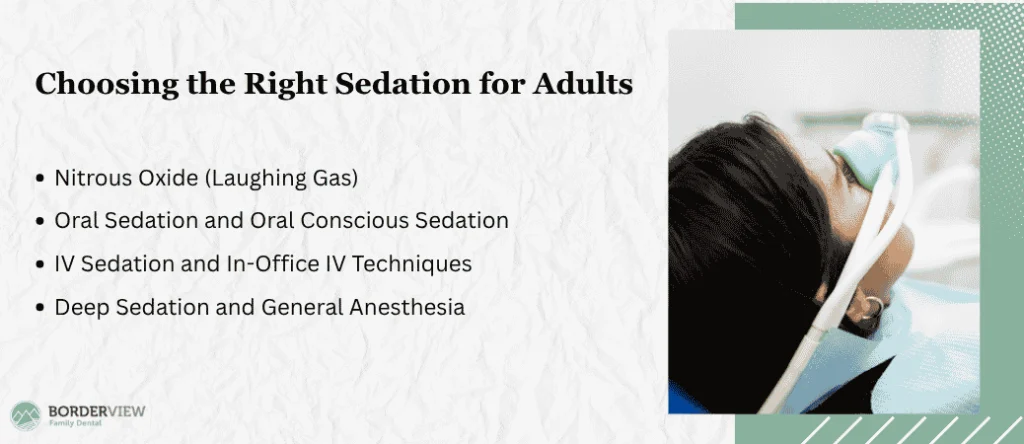
Nitrous Oxide (Laughing Gas)
Nitrous oxide is the mildest sedation option available at most dental offices. You breathe the gas through a small mask placed over your nose during your procedure.
The effects start within minutes and wear off quickly once your dentist turns off the gas. You stay awake and can respond to questions, but you feel relaxed and less anxious.
Many patients can drive themselves home after treatment because the gas leaves your system so fast.
Laughing gas works best if you have mild to moderate anxiety or need a short, simple procedure. It’s also a good choice if you want to stay alert during your appointment but need help staying calm.
Benefits of nitrous oxide:
- Wears off in minutes
- No needles required
- You can drive yourself home
- Easy to adjust dosage during treatment
Oral Sedation
Oral sedation involves taking a pill before your dental appointment to help you feel drowsy and relaxed. Your sedation dentist will prescribe a specific medication based on your needs and anxiety level.
You typically take the pill about an hour before your appointment. You’ll feel sleepy and calm during the procedure, but you remain conscious and can respond to instructions.
Most people don’t remember much about the appointment afterward.
Oral conscious sedation is stronger than nitrous oxide but doesn’t require an IV. You must arrange for someone to drive you to and from your appointment because the effects last several hours.
This option works well for patients with moderate anxiety or those who need longer procedures. Your dentist may adjust the dose based on your weight, medical history, and how anxious you feel.
IV Sedation and In-Office IV Techniques
IV sedation delivers medication directly into your bloodstream through a small needle in your arm or hand.
This method provides deeper relaxation than oral sedation and works faster because the medication doesn’t need to pass through your digestive system.
You enter a state of conscious sedation where you remain technically awake but deeply relaxed. Most patients have little to no memory of the procedure.
Your sedation dentist or dental anesthesiologist can adjust your sedation level throughout the appointment.
In-office IV sedation requires specialized training and monitoring equipment. Your dental team will track your heart rate, blood pressure, and oxygen levels during the entire procedure.
IV sedation is ideal for:
- Severe dental anxiety or phobia
- Long or complex procedures
- Patients who haven’t had dental care in years
- Multiple treatments in one visit
Deep Sedation and General Anesthesia
Deep sedation and general anesthesia represent the highest level of sedation available. Under general anesthesia, you’re completely unconscious and won’t respond to any stimulation during your procedure.
A dental anesthesiologist, oral surgeon, or physician anesthesiologist administers and monitors this level of sedation.
You’ll need advanced monitoring equipment and must fast for several hours before your appointment.
General anesthesia works best for extensive oral surgery, patients with severe medical conditions, or those with extreme dental phobia who cannot tolerate care any other way.
Recovery takes longer than other sedation options, and you’ll need someone to stay with you for the rest of the day.
Your dentist may refer you to a specialist for this level of sedation because it requires hospital-level training and equipment.
Benefits and Considerations of Each Sedation Type
Each sedation method offers different advantages and trade-offs in how well it manages anxiety, the safety profile it carries, and what you’ll pay out of pocket.
Understanding these differences helps you match the right option to your comfort needs and health situation.
Effectiveness for Dental Phobia and Anxiety
Nitrous oxide works well for mild to moderate dental anxiety because it creates relaxation while keeping you fully awake and responsive. You breathe it through a mask and feel calm within minutes.
The effects wear off quickly after the mask is removed, so you can usually drive yourself home.
Oral conscious sedation uses anxiety medication taken by mouth about an hour before your appointment. It provides deeper relaxation than nitrous oxide and works well for moderate dental phobia.
You remain awake but feel drowsy and may not remember much of the procedure.
IV sedation delivers medication directly into your bloodstream for stronger, faster effects. It’s effective for severe dental anxiety and longer procedures.
You stay semi-conscious but deeply relaxed, and most patients have little to no memory of the treatment.
General anesthesia puts you completely unconscious and works best for extreme dental phobia, extensive oral surgery, or patients with special needs.
You feel nothing and remember nothing from the procedure.
Safety and Risks
All sedation options for dental procedures are generally safe when administered by trained professionals. Nitrous oxide carries the lowest risk because it leaves your system quickly and doesn’t interact with most medications.
Oral sedation requires more caution if you have sleep apnea, respiratory problems, or take certain medications. You’ll need someone to drive you home and monitor you for several hours.
IV sedation and general anesthesia require the most training and monitoring equipment. Your oxygen levels, heart rate, and blood pressure are watched throughout the procedure.
These deeper levels work best when managed by a dental anesthesiologist or oral surgeon with specialized training.
You should share your complete medical history, all medications you take, and any past reactions to anesthesia before choosing a sedation level.
Heart disease, pregnancy, and certain drugs can affect which option is safest for you.
Cost and Insurance Coverage
Nitrous oxide typically costs the least and may be billed as a flat fee per visit. Many dental offices charge between $50 and $100 for nitrous oxide during a single appointment.
Oral conscious sedation usually falls in the mid-range for cost. IV sedation and general anesthesia cost more because they require specialized training, monitoring equipment, and longer chair time.
Dental insurance coverage for managing dental anxiety through sedation varies widely. Many plans only cover sedation when it’s medically necessary, such as for surgical extractions or patients with disabilities.
You should request a written estimate and ask your insurer about pre-authorization before your appointment.
Some medical insurance policies may cover part of hospital-based general anesthesia costs. Ask for an itemized estimate that separates sedation fees from procedure fees so you understand exactly what you’re paying for.
Finding Sedation Dentistry in Blaine
Several dental practices in Blaine offer sedation options to help you overcome dental anxiety.
You can find qualified providers who understand your concerns and provide safe, effective sedation dentistry tailored to your needs.
Choosing a Blaine Dentist
When looking for a sedation dentist in Blaine, you should start by checking which practices specifically advertise sedation services.
Borderview Family Dental offers sedation options designed to minimize stress and encourage relaxation during procedures.
You want to find Blaine dentists who have proper training and experience with the type of sedation you need.
Ask potential providers about their credentials and how many sedation cases they perform each year. Some complex procedures may require an oral surgeon who can provide deeper sedation levels.
You should also verify that the practice monitors patients properly during sedation. Check online reviews to see what other anxious patients say about their experiences.
What to Expect During Your Visit
Your first visit after the appointment will include a review of your medical history and discussion about your anxiety levels. The dentist will explain which sedation option works best for your situation.
Before the procedure, you’ll receive specific instructions about eating, drinking, and medications. For oral sedation, you’ll need someone to drive you to and from the appointment.
During treatment, the dental team will monitor your vital signs continuously. Most patients report limited memory of the procedure afterward.
You’ll feel relaxed but can still communicate with the dentist when needed.
Tips for Managing Dental Appointments
Schedule your appointments at times when you feel most calm, such as early morning before daily stress builds up. Bring headphones to listen to calming music or podcasts during your visit.
Before your appointment:
- Get plenty of sleep the night before
- Avoid caffeine if it increases your anxiety
- Arrive early to avoid rushing
- Bring a trusted friend or family member for support
Tell your dentist about specific triggers that worsen your anxiety. They can adjust their approach to help you feel more comfortable.
Managing dental anxiety becomes easier when you have a dentist who listens and works with you rather than avoiding the dentist altogether.
Frequently Asked Questions
Adults in Blaine have access to multiple sedation levels, from nitrous oxide to IV sedation, each with different comfort levels and recovery times.
Understanding what happens during the visit, safety considerations, and how to find the right provider can help you make an informed choice.
What sedation options can help adults who feel anxious or fearful about dental visits?
You can choose from several sedation options based on your level of dental anxiety. Nitrous oxide, also called laughing gas, offers mild relaxation through a nasal mask.
You stay awake and aware during the procedure.
Oral sedation involves taking a pill before your appointment to create moderate relaxation. You may feel drowsy but can still respond to questions.
IV sedation delivers medication through a vein for deeper relaxation. Many patients have little to no memory of the procedure afterward.
General anesthesia is the deepest option where you are completely unconscious. This choice is typically reserved for complex surgical procedures or severe phobia.
How do oral sedation and IV sedation compare for comfort, relaxation, and recovery time?
Oral sedation takes effect within 30 to 60 minutes after you swallow the pill. The level of drowsiness can vary from person to person, and your dentist cannot easily adjust the dose once you have taken it.
IV sedation works much faster, usually within minutes. Your provider can adjust the medication level throughout your appointment to keep you comfortable.
Recovery from oral sedation can take several hours, and you may feel groggy for the rest of the day. IV sedation also requires recovery time, but the effects often wear off more predictably since your provider controls the dose.
Both options require you to have someone drive you home and stay with you. You should not operate vehicles or make important decisions for at least 24 hours.
What should I expect before, during, and after IV sedation at a dental appointment?
Before your appointment, you will need to fast for several hours. Your dental team will review your medical history and current medications.
At check-in, the staff will record your vital signs and connect you to monitors. These track your oxygen level, heart rate, and blood pressure throughout the procedure.
During treatment, the dentist places a small needle in your arm or hand to deliver the sedation medication.
You will feel deeply relaxed or may drift in and out of sleep while the dental work happens.
After the procedure, you will rest in a recovery area until you are alert enough to leave. You may experience mild grogginess, nausea, or a dry mouth. These side effects typically go away within a day.
Is dental sedation generally safe for healthy adults, and what risks should I ask about?
Sedation dentistry is generally safe when performed by trained providers who monitor you closely. Healthy adults typically have very low complication rates.
You should tell your dentist about any heart disease, lung conditions, sleep apnea, or allergies to medications. These conditions may affect which sedation option is safest for you.
Common side effects include drowsiness, dry mouth, mild nausea, and temporary memory gaps. Serious complications are rare but can include breathing problems or allergic reactions.
Your provider should explain the specific risks based on your health history. Ask how they will monitor you and what emergency equipment they have on hand.
What medications are commonly used for dental sedation, and how does a dose like diazepam typically fit in?
Nitrous oxide is a gas you inhale through a mask for mild anxiety relief. The effects wear off within minutes after you stop breathing it.
Oral sedation often uses medications from the benzodiazepine family. Diazepam is one option that helps reduce anxiety and creates muscle relaxation.
Other common choices include triazolam and lorazepam.
IV sedation may use midazolam, a fast-acting benzodiazepine, often combined with pain medication like fentanyl. Your provider adjusts the dose based on your response during the procedure.
General anesthesia uses stronger medications like propofol to make you unconscious. A dental anesthesiologist or physician anesthesiologist manages these deeper levels of sedation.
How do I find a local dental office that offers sedation for anxiety and what questions should I ask when booking?
Many general dentists in Blaine offer nitrous oxide and oral sedation. For IV sedation or general anesthesia, you may need to see a specialist like an oral surgeon or dental anesthesiologist.
When you call to book, ask which sedation levels the office provides. Find out if the dentist has completed training and holds the proper permits for the sedation types they offer.
Request an itemized cost estimate that separates sedation fees from the dental procedure fees. Ask whether your dental insurance covers sedation for your specific situation.
Confirm that the office has monitoring equipment and emergency protocols in place. Ask if you will need someone to drive you home and how long you should plan for recovery.


