
Clear aligners have become a popular choice for straightening teeth, but the price can vary significantly from one person to another. If you’re considering orthodontic treatment, you might wonder why costs differ so much between providers and patients.
Clear aligner treatment typically costs between $2,000 and $8,000, depending on factors like the brand you choose, how complex your case is, and whether an orthodontist supervises your care.
Understanding what drives these price differences helps you make a smart decision about your teeth straightening journey.
The cost of your orthodontic treatment depends on more than just the aligners themselves.
Your specific smile needs, the technology used to plan your treatment, the length of time you’ll wear aligners, and the level of professional supervision all play a role in determining what you’ll pay.
Key Takeaways
- Treatment cost varies based on how much correction your teeth need and how long treatment takes
- Different aligner brands use different technology and supervision levels, which affects pricing
- Insurance coverage and payment plans can make clear aligners more affordable for your budget
Table of Content
- Complexity of Your Smile and Treatment Plan
- Professional Guidance and Supervision
- Aligner Brands and Technology Differences
- Cost Breakdown, Insurance, and Payment Options
- Making the Right Choice for Your Smile
- Frequently Asked Questions
Complexity of Your Smile and Treatment Plan
The severity of your dental issues determines how many aligners you’ll need and how long treatment will take.
Your orthodontist creates a treatment plan based on specific problems like crowding, spacing, and bite corrections that need fixing.
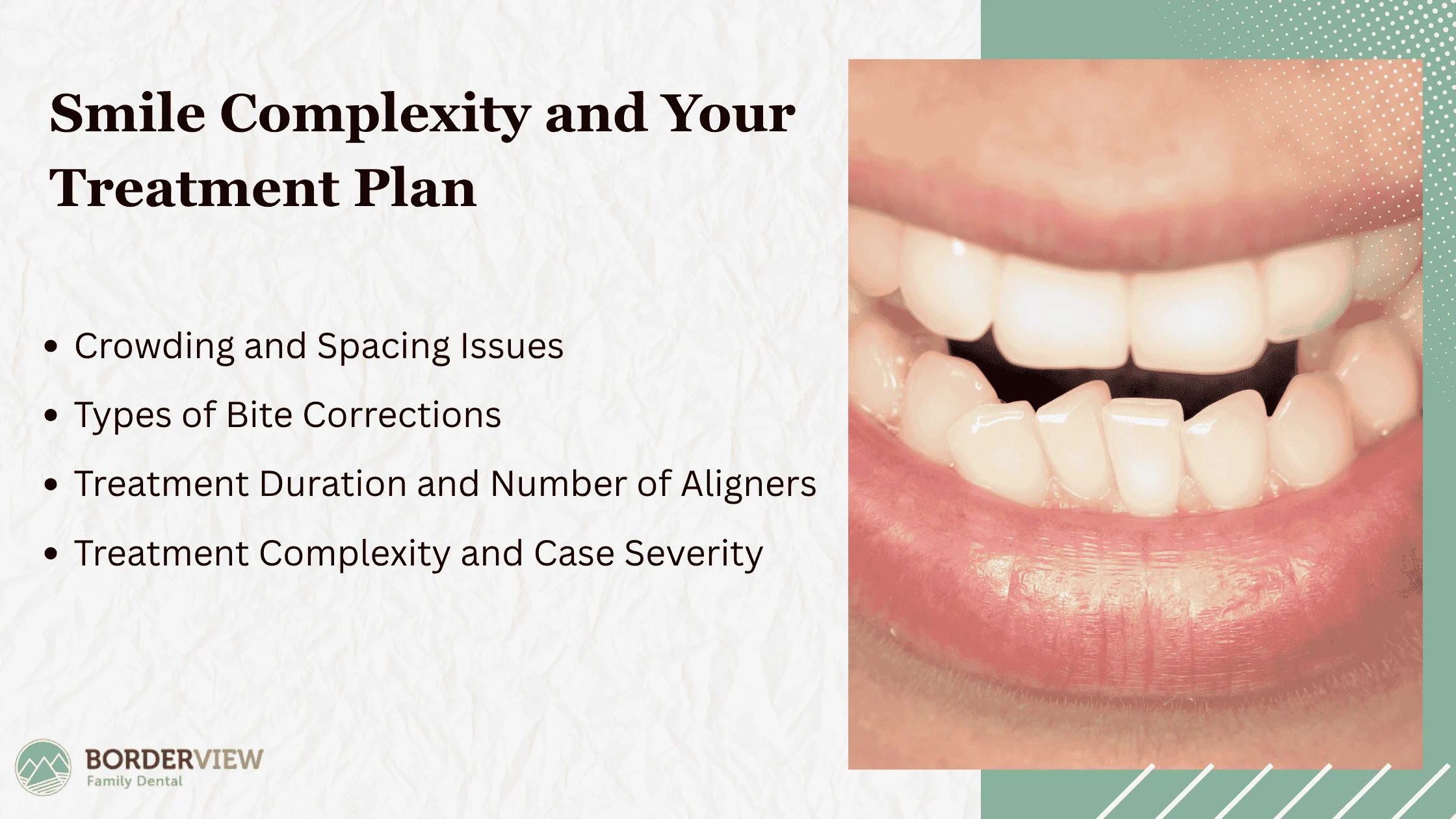
Crowding and Spacing Issues
Crowding happens when your teeth overlap or twist because there isn’t enough room in your jaw. Mild crowding affects just a few teeth and typically requires 10 to 20 aligners over 4 to 10 months.
This straightforward issue costs less because you need fewer aligner trays and progress checks.
Moderate to severe crowding involves multiple teeth that need significant movement. Your treatment plan might include 25 to 40 aligners over 12 to 18 months.
Treatment complexity increases when crowding is severe, which means more monitoring appointments and possibly refinement trays.
Spacing issues occur when you have gaps between teeth. Small gaps close relatively quickly with fewer aligners. Larger gaps or multiple spaces throughout your mouth require more time and aligners to close properly.
Types of Bite Corrections
Bite issues add complexity to your aligner treatment cost because they involve moving your entire jaw relationship. An overbite means your top teeth overlap your bottom teeth too much.
A crossbite happens when some upper teeth sit inside your lower teeth when you bite down.
An underbite occurs when your lower teeth stick out past your upper teeth. An open bite leaves a gap between your top and bottom teeth even when your mouth is closed.
These bite problems often require attachments, which are small tooth-colored bumps bonded to your teeth to help aligners grip better.
Complex bite corrections typically need 18 to 24 months of treatment with 35 to 50 aligners. Your orthodontist uses a digital simulation to show how your teeth and bite will shift throughout treatment.
This detailed planning ensures your bite functions correctly when treatment ends.
Treatment Duration and Number of Aligners
Your treatment duration directly connects to how many aligners you’ll wear. Each aligner set typically stays in your mouth for one to two weeks before switching to the next one.
A 12-month treatment plan means you’ll go through approximately 26 to 52 different aligner sets.
Shorter treatments with fewer aligners cost less than extended ones. If you only need minor adjustments, you might finish in 4 to 6 months with 10 to 15 aligners.
More extensive tooth movement requires 18 to 24 months with 40 to 50 aligners or more.
Progress monitoring throughout your treatment ensures your teeth move according to plan. Regular progress checks catch any issues early, though sometimes you’ll need refinement trays if teeth don’t move exactly as the simulation predicted.
Treatment Complexity and Case Severity
Case complexity ranks as the biggest factor affecting your final price. Mild cases involving small adjustments to a few teeth cost between $1,000 and $4,500. These simple corrections need minimal supervision and fewer aligners.
Moderate cases with noticeable crowding, spacing, or bite problems fall in the $4,500 to $5,500 range. You’ll need more frequent monitoring and a longer treatment plan to achieve the desired results.
Complex cases involving severe crowding, significant bite corrections, or major tooth movements can cost $6,000 to $8,000 or more.
These treatments demand the most aligners, longest duration, and closest professional oversight. Your orthodontist might need to adjust your treatment plan partway through, adding refinement trays to perfect your smile.
| Case Severity | Number of Aligners | Treatment Duration | Typical Cost Range |
| Mild | 10-20 | 4-10 months | $1,000-$4,500 |
| Moderate | 20-35 | 10-18 months | $4,500-$5,500 |
| Complex | 35-50+ | 18-24+ months | $6,000-$8,000+ |
Professional Guidance and Supervision
The level of professional oversight you receive during aligner treatment directly affects both the cost and the safety of your results.
Orthodontists and dentists bring different levels of expertise to treatment planning, and choosing between in-office and at-home options means weighing professional supervision against convenience and price.
Role of Orthodontists and Dentists
An orthodontist completes an additional two to three years of specialized training beyond dental school focused exclusively on tooth movement and jaw alignment.
This expertise becomes crucial when your case involves bite correction, rotations, or complex tooth movements.
A general dentist can also provide aligner treatment and often charges less than an orthodontist. Many dentists have completed continuing education courses in clear aligner therapy and successfully treat mild to moderate cases.
Orthodontist supervision typically costs more because specialists handle complicated cases that require attachments, interproxial reduction, or refinements.
Your orthodontist can identify problems like temporomandibular joint (TMJ) disorders or bone loss that might worsen without proper monitoring.
Dentist supervision works well for straightforward cosmetic adjustments. Your dentist already knows your dental history and can coordinate aligner treatment with other procedures like fillings or crowns.

In-Office vs. At-Home Supervision
In-office aligners require regular appointments every six to ten weeks where your provider checks your progress, addresses concerns, and makes adjustments.
You pay $3,500 to $8,000 for this hands-on care, but you get professional accountability throughout treatment.
At-home aligners or DTC aligners (direct-to-consumer aligners) cost $1,500 to $3,300 and use smartphone apps for remote monitoring. You send photos of your teeth every few weeks instead of visiting an office.
Mail-order aligners skip the initial in-person evaluation that orthodontists recommend. This saves money but increases risk if you have underlying issues like gum disease or need a root canal.
The American Association of Orthodontists warns that starting treatment without X-rays and a clinical exam can miss serious problems.
Some direct-to-consumer aligner brands now require scans at partner locations, which adds a layer of safety compared to purely remote options.
Consultation and Smile Assessment
Most orthodontic offices offer a free consultation where you discuss your goals and concerns. During this visit, your provider performs a smile assessment to evaluate tooth alignment, spacing, and bite relationship.
Digital scans using intraoral cameras have replaced messy putty impressions at most modern practices. These digital impressions create a 3D model of your teeth in minutes and feel more comfortable than traditional methods.
At-home options send you a home impression kit or impression kit to create molds of your teeth yourself. You mail these back to the company, which uses them to design your aligners.
This process works for simple cases but carries higher risk of fitting errors if you don’t capture accurate impressions.
Your consultation should address whether you need any preliminary work before starting aligners. Cavities, gum inflammation, or missing teeth might require treatment first.
Evaluating Candidacy and Health Concerns
Not everyone qualifies as a good candidate for clear aligners. Your provider performs an orthodontic evaluation to check for conditions that might complicate treatment or require traditional braces instead.
Gum disease must be controlled before moving teeth. Active periodontal disease can lead to bone loss and tooth mobility if you start aligners without treatment. Your dentist will check your gum health during the evaluation.
TMJ problems need assessment before treatment begins. Some patients experience jaw pain relief with aligners, while others might need additional therapy if bite changes trigger discomfort.
Previous dental work like crowns or bridges affects treatment planning. Your provider needs to know about any root canal therapy or implants since these teeth move differently than natural teeth.
Your evaluation should cover post-treatment retainers and the long-term commitment required. Retainers prevent your teeth from shifting back after professional supervision ends.
Aligner Brands and Technology Differences
The brand you choose affects both your total cost and your treatment outcome.
Different companies use varying materials, software systems, and manufacturing processes that directly impact how well your aligners fit and how predictably your teeth move.
Comparing Popular Brands and Pricing
Clear aligner treatment typically costs between $2,000 and $8,000 depending on which brand you select.
Invisalign remains the most expensive option at $3,000 to $9,500 because it treats the widest range of cases and includes the most advanced technology. ClearCorrect and Spark Aligners fall into a similar mid-range category.
CandidPro operates differently by combining in-office exams with remote monitoring. Your treatment costs $3,500 to $6,000 through their hybrid model.
Byte, NewSmile, and ALIGNERCO represent the budget end of the market. Byte charges $2,199 to $2,399 while NewSmile starts at just $1,495.
These brands only handle simple cosmetic cases like minor crowding or small gaps. SureSmile offers another mid-tier option through dental offices with pricing that varies by provider.
Materials and Manufacturing Quality
Not all aligner plastic performs the same way. Invisalign uses their proprietary SmartTrack material, which they developed specifically for tooth movement.
SmartTrack delivers more consistent force over time compared to standard thermoplastic materials.
The thickness and flexibility of your aligners matter for comfort and effectiveness. Premium brands use multilayer materials that resist staining and cracking better than cheaper alternatives.
Lower-cost brands often use thinner plastic that may not apply enough pressure for predictable movement.
Manufacturing precision affects how well your aligners fit your teeth. Invisalign, Spark Aligners, and SureSmile use advanced 3D printing with tight tolerances.
Budget brands sometimes produce aligners with less precise edges that can irritate your gums or fail to grip your teeth properly.
Treatment Planning Software and Digital Dentistry
Your treatment planning software determines how accurately your provider can predict results. Invisalign’s ClinCheck software now includes AI that analyzes millions of previous cases to improve movement predictions.
You can see your projected final smile before you commit to treatment.
SureSmile and Spark Aligners offer similar 3D treatment planning tools through dental offices. These systems let your dentist simulate different treatment approaches and show you multiple outcome scenarios.
Remote brands like Byte and ALIGNERCO use simpler planning software since they handle only basic cases. You’ll still see a digital preview, but the software can’t account for complex tooth rotations or bite corrections.
CandidPro assigns board-certified orthodontists to design your plan, giving you more sophisticated treatment design than fully remote options.
Special Features and Add-On Options
Some brands include extras that add value beyond the basic aligners. Byte bundles their HyperByte vibration device with every treatment to help seat your aligners more comfortably.
They also include BrightenByte whitening foam at no extra charge.
Replacement trays vary by brand. Invisalign typically charges $100 to $250 per replacement tray if you lose one. Many affordable clear aligners like NewSmile and ALIGNERCO include your first set of replacement trays free.
Byte offers their “Byte for Life” guarantee covering future refinements. CandidPro includes remote monitoring through their app with photo check-ins.
Premium brands often provide better retention programs and longer warranties, while budget options may leave you paying out of pocket if you need adjustments after your initial treatment ends.
Cost Breakdown, Insurance, and Payment Options
Clear aligners typically range from $1,200 to $8,000 depending on your treatment complexity and provider type.
Most orthodontic insurance plans cover a portion of aligner costs, and flexible payment options make treatment accessible even without full upfront payment.
Average Price Ranges by Case and Location
At-home clear aligners cost between $549 and $1,499 for mild to moderate cases. These companies like ALIGNERCO and Smileie monitor your treatment remotely without regular office visits.
In-office treatments range from $2,500 to $8,000. Invisalign typically costs $3,000 to $8,000, while ClearCorrect ranges from $2,500 to $5,500. These higher prices reflect direct orthodontist supervision throughout your treatment.
Hybrid options like Candid fall in the middle at around $3,300. You visit a dental provider for initial scans and final check-ups but receive remote monitoring during treatment.
Your geographic location also affects pricing. Treatment in major cities often costs more than in smaller towns due to higher overhead expenses.
Insurance and Orthodontic Benefits
Many dental insurance plans provide orthodontic benefits that cover clear aligners similarly to traditional braces. Check with your insurance provider to determine your specific coverage percentage.
Most plans cover 25% to 50% of treatment costs up to a lifetime maximum of $1,000 to $3,000. Your plan may require pre-authorization before starting treatment.
Health Savings Accounts (HSA) and Flexible Spending Accounts (FSA) can pay for both at-home and in-office aligners. These tax-advantaged accounts let you use pre-tax dollars for orthodontic care.
If you don’t have insurance, discount dental plans offer reduced rates at participating providers. These membership programs provide immediate dental savings on aligner treatments.
Monthly Payment Plans and Financing Solutions
Most clear aligner companies offer monthly payment plans to make treatment affordable. ALIGNERCO charges $725 to $925 total with payment options that spread costs over several months.
In-office providers typically offer in-house payment plans with little to no interest if paid within a specific timeframe. Some orthodontists partner with third-party financing companies that offer longer terms.
At-home aligner companies often provide:
- Pay-in-full discounts (save 5% to 15%)
- Interest-free monthly payments over 6 to 24 months
- Low down payment options starting around $250
Ask about promotional financing before starting treatment. Many providers offer special rates during certain times of the year.
Long-Term Costs: Retainers and Refinements
Your treatment cost should include post-treatment retainers to maintain your results. Most companies provide one set of retainers with your initial treatment package.
Replacement retainers typically cost $100 to $300 per set. You’ll need new retainers every 1 to 2 years as they wear down from nightly use. Some companies offer retainer subscription services for ongoing retention.
Refinements may be necessary if your teeth don’t align perfectly or shift after treatment. Many at-home aligner companies include one free refinement in their original price. In-office providers often charge $500 to $1,500 for additional aligner sets.
Budget for these ongoing costs when calculating your total investment. Proper retention prevents the need for future orthodontic work.
Making the Right Choice for Your Smile
The treatment you choose depends on your specific dental needs, lifestyle preferences, and budget.
Understanding how aligners compare to other options helps you make an informed decision about what works best for you.
Aligners vs. Braces and Other Alternatives
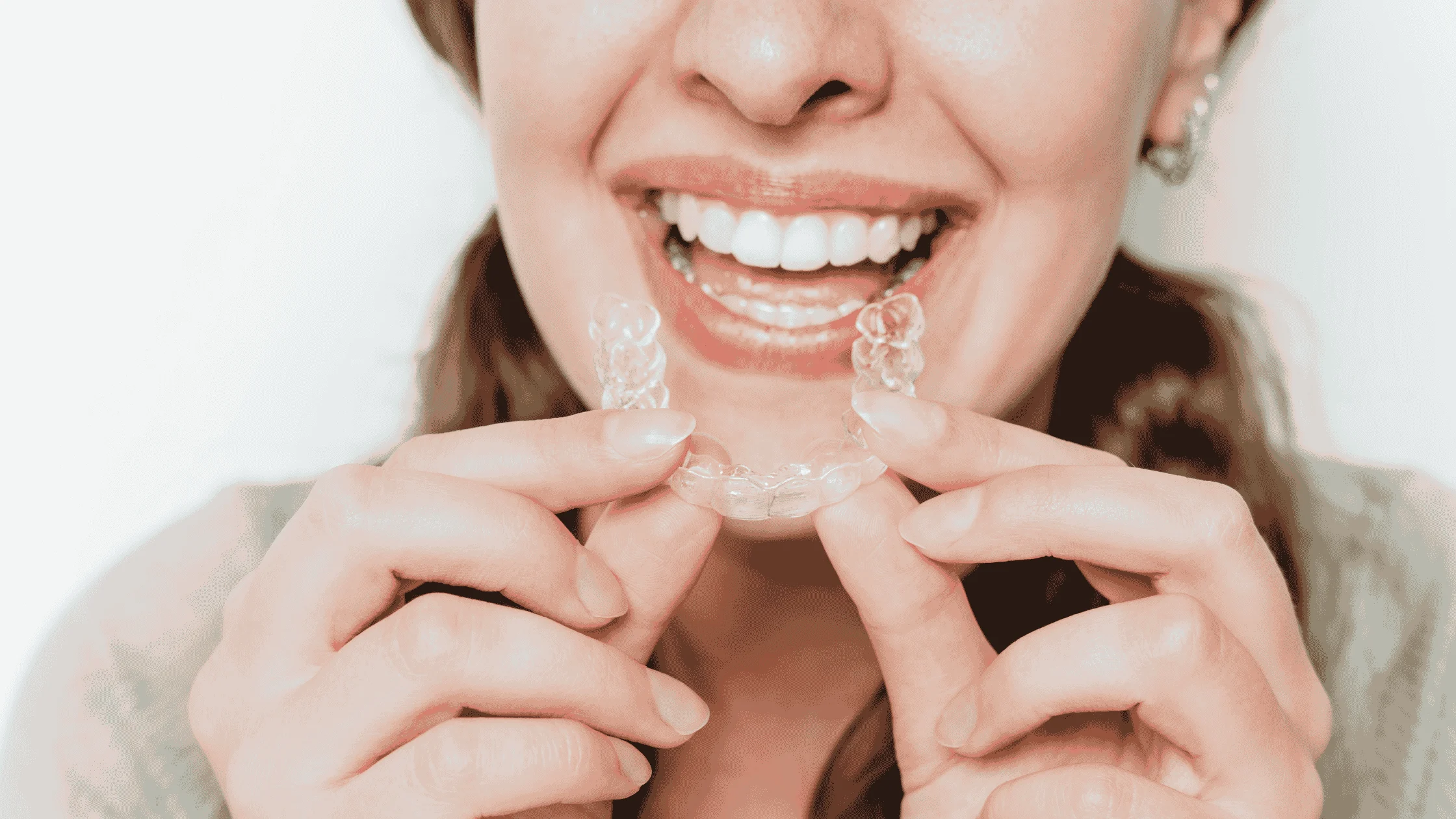
Clear aligners work well for mild to moderate cases like gaps, crowding, and minor bite issues. They’re removable, nearly invisible, and let you eat whatever you want.
Traditional metal braces are often better for complex bite corrections and severe alignment problems. They stay on your teeth 24/7, which means you can’t take them off.
Ceramic braces offer a middle ground with tooth-colored brackets that blend in better than metal. When comparing aligners vs braces, both typically cost between $3,000 and $8,000 depending on your case.
The clear aligners vs braces debate comes down to your priorities. Aligners mean fewer office visits and easier cleaning. Braces require more frequent adjustments but work on tougher cases.
Assessing Value, Safety, and Suitability
Your dentist will examine your teeth, bite, and jaw during a consultation. They’ll take digital scans or impressions to map your treatment plan.
Not everyone qualifies for aligners. Severe crowding, significant bite problems, or rotated teeth might need braces instead.
Safety depends on choosing a qualified provider. Work with a licensed dentist or orthodontist who has experience with aligner systems. They’ll monitor your progress and catch any issues early.
Value goes beyond just price. Think about how treatment fits your daily life. Can you commit to wearing aligners 20-22 hours per day? Will you remember to put them back in after meals?
Ask about what’s included in your quote. Most plans cover all aligners, office visits, and retainers. Some practices charge extra for replacements if you lose a tray.
Next Steps: From Assessment to Treatment
Schedule a consultation with a dental professional to discuss your goals and concerns. They’ll evaluate whether you’re a good candidate for aligners or if another option suits you better.
Your provider will explain what factors affect pricing for your specific case. Get a detailed treatment plan that shows the timeline and total cost.
Ask about payment options during your visit. Many offices offer monthly plans, accept HSA and FSA funds, or work with financing companies. Check if your dental insurance covers orthodontic treatment.
Once you agree to move forward, your provider creates your custom aligners. You’ll receive your first sets and instructions on how to wear and care for them.
Plan for regular check-ins every 6-8 weeks. Your dentist tracks your progress and gives you new aligner sets. Most treatments take 6-18 months depending on complexity.
Frequently Asked Questions
The price you pay depends on several personal factors including how much your teeth need to move, which aligner brand you choose, and whether an orthodontist or general dentist manages your treatment.
What makes the price of clear aligners vary from one person to another?
Your unique treatment needs determine your final cost. Two people getting the same brand of aligners can pay different amounts based on how many trays they need and how long treatment takes.
Your location also affects pricing. Orthodontists in major cities typically charge more than those in smaller towns due to higher overhead costs.
Insurance coverage varies by plan. Some policies cover $1,000 to $3,000 toward clear aligners, while others offer no orthodontic benefits at all.
How does the complexity of my teeth alignment affect the total cost?
Simple cases with mild crowding or spacing cost less because they require fewer aligner trays. These treatments might only need 10 to 15 sets of aligners over 6 to 8 months.
Complex cases involving bite problems, severe crowding, or significant rotations need more trays and longer treatment times. You might need 30 to 40 sets of aligners over 12 to 18 months.
More complex treatments also require more frequent monitoring visits. Your orthodontist needs to check that your teeth are moving correctly and may need to order refinement trays if adjustments are needed.
Do the brand and type of clear aligner system change the overall price?
Different brands charge different amounts for their products. Invisalign typically ranges from $3,500 to $7,000, while ClearCorrect costs between $2,000 and $5,500.
Direct-to-consumer options like SmileDirectClub or Byte range from $1,800 to $2,400. These lower prices reflect the lack of in-person supervision and monitoring.
The technology each brand uses also impacts cost. Some systems use more advanced software for treatment planning or offer features like progress tracking apps.
How do dentist or orthodontist fees and experience impact what I’ll pay?
Orthodontists generally charge more than general dentists because of their specialized training. They complete an additional two to three years of education beyond dental school focused specifically on moving teeth.
Your provider’s experience level affects pricing too. Doctors with decades of experience or advanced certifications often charge premium rates for their expertise.
The level of supervision included matters significantly. Treatment through an orthodontist costs more than direct-to-consumer options but includes regular in-person visits and professional adjustments.
What’s typically included in the quoted price, and what might cost extra?
Most quotes include your initial consultation, digital scans or impressions, all aligner trays for your planned treatment, and scheduled progress check appointments. The price usually covers attachments if needed and one set of retainers after treatment.
Extra costs can pop up if you need refinement trays beyond what was originally planned. Lost or broken aligners that need replacement add to your total.
Some offices charge separately for X-rays, pre-treatment cleanings, or tooth extractions if needed. Ask for a detailed breakdown of what your quote includes before starting treatment.
Is $7,000 a typical price for clear aligners, and what could make it higher or lower?
Most clear aligner treatments range from $2,000 to $6,500 depending on complexity and length. A $7,000 price point sits at the higher end of the typical range.
You might pay $7,000 or more for complex cases that need extensive tooth movement, bite correction, or treatment lasting 18 months or longer. Choosing Invisalign with an experienced orthodontist in a high-cost area can also push prices to this level.
Prices drop below $3,000 for mild cases treated with less expensive aligner brands or direct-to-consumer options. Short treatment times of 6 months or less with minimal monitoring also reduce costs.