


If you’ve worn dentures for years, you’ve probably wondered whether dental implants are still an option. The good news is that the answer is usually yes.
For long-time denture wearers who have lost jawbone, bone grafting for dental implants can rebuild the support needed for successful implant placement.
Not everyone needs one, either. Some people keep enough bone to move straight to implants, while others do better with extra support built in first.
Timing matters too. Healing after a bone graft often takes three to nine months before the implant goes in, and your dentist will tell you when it’s safe to wear your denture again. Here’s what that whole process looks like, step by step.
Key Takeaways
- Years without tooth roots can shrink your jawbone and change how implants are planned.
- A scan and exam show whether you need a graft and which type fits your case.
- Healing takes months, but the result is a stable set of teeth you can care for long term.
Table of Content
- Why Years of Denture Wear Can Change Your Jawbone
- Finding Out Whether You Need a Graft
- Grafting Options That Rebuild Implant Support
- Your Treatment Timeline From Graft to New Teeth
- Choosing the Right Implant Restoration and Protecting Results
- Frequently Asked Questions
Why Years of Denture Wear Can Change Your Jawbone
If you’ve worn dentures for a decade or more, your jaw likely looks different today than it did when you first got them.
Tooth roots, gum health, and daily chewing pressure all play a part in how much bone you keep and how much you lose.
How Tooth Loss Triggers Bone Resorption
Your jawbone stays strong because tooth roots press into it every time you chew. That pressure sends a signal that the bone is still needed.
When a tooth comes out, that signal stops. The bone around the empty socket starts to break down in a process called resorption.
This happens faster than most people expect. Studies show that 25% of the jaw’s width can disappear within the first year after an extraction.
Bone loss slows down after that, but it never fully stops. Each year without roots in place means a little less height and width in the ridge that once held your teeth.
Why Removable Dentures Do Not Preserve Bone
Removable dentures rest on top of your gums. They restore your smile and help you chew, but they don’t reach into the bone the way natural roots do.
That’s the key difference. Dentures and bridges replace teeth but not what sits underneath them, so the jawbone keeps shrinking year after year.
In some cases, the pressure from a full denture pressing down on the ridge can even speed things up.
You may have noticed the signs already:
- Your denture feels loose a few months after a reline
- Sore spots show up in new places
- Adhesive doesn’t hold as well as it used to
- Lower dentures shift when you talk or laugh
Each of those changes usually points back to a ridge that’s flattening out underneath.
Jawbone Shrinkage and Changes in Facial Support
Your jawbone does more than hold teeth. It also supports your lips, cheeks, and the lower third of your face.
As the ridge shrinks, that support fades. Long-term denture wearers often see their chin move forward, deep lines form around the mouth, and the lips look thinner. Dentists sometimes call this pattern facial collapse.
The upper jaw has an extra challenge. Your sinus cavities can expand downward into space where bone used to be, which reduces the height available for an implant in the back of the mouth.
This matters for planning. Less bone means your dentist may recommend a graft, a sinus lift, or angled implants that reach into denser areas.
How Gum Disease Can Worsen Bone Loss
If gum disease was the reason you lost your teeth, you likely started your denture years with less bone than average.
Periodontal disease destroys the bone that holds teeth in place, and that damage happens before any extraction. Once the teeth are gone, denture wear continues the pattern.
The result is often an uneven ridge, thicker in some spots, very thin in others. Your dentist sees this on a 3D scan and plans around it.
Gum health still matters after tooth loss, too. Irritated tissue under a poorly fitting denture can affect your overall oral health and the stability of your jaw bone, so regular checkups are worth keeping even without natural teeth.

Finding Out Whether You Need a Graft
Nobody can tell if you need a bone graft just by looking in your mouth. The answer comes from a hands-on dental exam, a 3D scan that measures how much bone is left, and an honest look at your health habits.

What Happens During the Dental Exam
Your first visit usually starts with a conversation. Your dentist will ask how long you’ve worn dentures, how often they slip, and whether you’ve had any teeth removed recently.
Then comes the hands-on part. Your dentist checks your gums for redness, bleeding, or signs of gum disease, and feels along your jaw ridge to see how thin or flat it has become.
They’ll also look at how your upper and lower jaws line up when you bite. Long-term denture wear can change that alignment.
Expect a review of your medical history too, including medications and any conditions like diabetes. Some offices take standard X-rays at this visit, but those flat images only show part of the picture.
Measuring Bone Volume and Bone Density With a CT Scan
A cone beam CT scan (CBCT) is the tool that gives real answers. It takes a 3D image of your jaw in less than a minute, and you stay seated the whole time.
At Borderview Family Dental, Dr. Gagan Sandhu uses detailed imaging and a comprehensive dental evaluation to assess the available jawbone and determine whether grafting may be needed before implant placement.
Your dentist uses that scan to measure two things:
- Bone volume: The height and width of bone available at each planned implant site
- Bone density: How solid that bone is, since soft, spongy bone holds an implant less securely
The scan also shows where your sinuses and nerves sit. That matters a lot in the upper back jaw, where the sinus often drops down after years of bone loss.
Whether you really need a graft comes down to those measurements, the bone quality, and the exact spot in your mouth. Some people walk out with a very different timeline than they expected, in a good way.
Factors That Affect Implant Eligibility
Bone measurements matter, but they’re not the only thing on the list.
| Factor | Why it matters |
| Smoking | Slows healing and raises the chance a graft or implant fails |
| Uncontrolled diabetes | Delays healing and increases infection risk; well-managed diabetes is far less of a concern |
| Gum disease | Active infection needs treatment first, since it damages the bone you’re trying to build |
| Oral hygiene | Daily brushing and cleaning habits affect how well implants hold up long term |
| Bone location | The lower front jaw usually has denser bone than the upper back jaw |
Your dentist may ask you to cut back on smoking, get your blood sugar under better control, or treat gum inflammation before surgery is scheduled. For older adults considering dental implants after 60, overall health and bone quality often matter more than age alone. These steps directly affect your results.
When a Specialist Consultation Is Recommended
Plenty of general dentists place straightforward implants. But some cases call for extra training.
You’ll likely be referred to an oral surgeon or periodontist if:
- Your scan shows severe bone loss across the whole ridge
- You need a sinus lift in the upper jaw
- Bone must be harvested from another part of your body
- You have a medical condition that complicates surgery
A specialist can also explain alternatives to grafting, such as shorter implants or angled placement that uses the bone you already have.
It’s fine to ask for a second opinion. Getting two sets of eyes on your CT scan costs you a little time and can save you from unnecessary surgery.
Grafting Options That Rebuild Implant Support
Years of denture wear can shrink the ridge of bone that once held your teeth, so your surgeon picks a grafting method based on where the bone is thin and how much is missing.
Some cases need a small amount of material tucked into one spot, while others call for rebuilding the whole ridge or making room under the sinus.
Socket Grafts and Ridge Augmentation
A socket graft fills the empty space left right after a tooth extraction. It keeps the walls of the socket from collapsing while you heal.
If you’ve worn dentures for years, that window has usually passed. In that case, ridge augmentation is the more likely plan.
Ridge augmentation rebuilds a jaw ridge that has become too narrow or too short for an implant. Graft material is packed along the outside of the bone, covered with a membrane, and left to heal.
For severe bone loss, your surgeon may use a block bone graft, where a small piece of bone is taken from another part of your jaw and held in place with tiny screws.
Healing usually runs 3 to 9 months, and the timeline varies by graft type and location.
Preserving bone after an extraction can also make future single tooth dental implant placement more predictable.
Sinus Lift Procedures for the Upper Jaw
Your upper back jaw sits directly below the sinus cavity. When those molars are gone, the bone thins from below and the sinus can drop lower.
That leaves too little bone volume to anchor an implant safely. A sinus lift solves this.
Your oral surgeon gently raises the sinus membrane and places graft material in the space underneath. New bone forms in that pocket over the next several months.
Two common approaches:
| Type | Best for | How it works |
| Lateral window | Larger bone gaps | Access through the side of the jaw |
| Crestal (internal) | Small gains of 2-3 mm | Access through the implant site itself |
Sometimes the implant goes in during the same visit. Other times you wait about four to six months.
Donor Bone and Other Graft Materials
You have several material choices, and none of them require a second surgical site unless you and your surgeon choose that route.
- Autograft: Your own bone, often from elsewhere in the jaw
- Allograft: Processed donor bone from a tissue bank
- Xenograft: Treated bone from an animal source, usually bovine
- Alloplast: Synthetic bone substitutes made from minerals like hydroxyapatite or calcium phosphate
Donor and synthetic graft materials act as a scaffold. Your body slowly replaces them with your own bone through a process called bone regeneration.
Some practices also offer autogenous dentin grafting, which uses a tooth extracted during the same appointment as the graft material.
Cost shifts with the material you pick. Ask for a written estimate before you agree.
Guided Bone Regeneration and Combined Procedures
Guided bone regeneration uses a thin barrier membrane over the graft. The membrane keeps fast-growing gum tissue out so bone cells get the space and time they need.
Membranes can be resorbable, meaning they dissolve on their own, or non-resorbable, which your periodontist removes later.
Long-term denture wear often means more than one problem at once. Your plan may combine a sinus lift on one side with ridge augmentation on another.
In some cases, full-arch techniques use strategically positioned implants to make better use of the bone that remains.
Your dentist can determine whether you meet the criteria for All-on-4 dental implant candidacy after reviewing your bone structure and overall oral health.
If bone loss is very advanced, your surgeon might discuss other approaches that use denser areas of available bone.
A 3D cone beam scan maps your remaining bone first, so the sequence of treatment is planned before anything begins.
Your Treatment Timeline From Graft to New Teeth
Going from a bone graft to a finished set of implant teeth usually takes somewhere between 9 and 15 months, and long-term denture wearers often land on the longer end of that range because more bone needs rebuilding.
Knowing what happens at each visit makes the wait feel much more manageable.
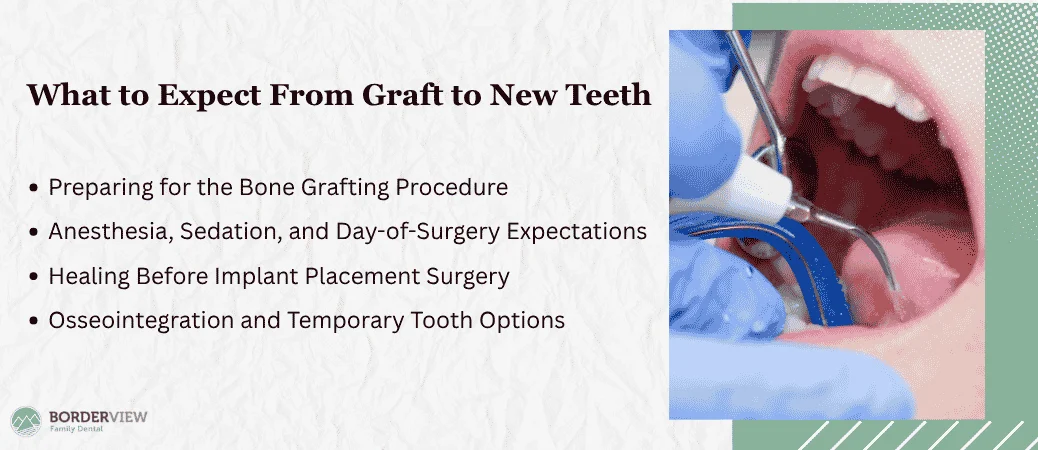
Preparing for the Bone Grafting Procedure
Your first appointment is all about planning. Your surgeon will take a 3D cone beam scan to measure exactly how much bone height and width you have left in each area of your jaw.
You will also go over your health history. Conditions like diabetes, smoking, and osteoporosis medications can slow healing, so your team may adjust the plan or ask you to make changes first.
Expect a few practical instructions before surgery day:
- Fill prescriptions early for antibiotics or pain medicine
- Arrange a ride home if you are having sedation
- Stock soft foods like yogurt, soup, eggs, and smoothies
- Bring your existing dentures so they can be adjusted or relined
Ask now whether you can wear your denture during healing. In many cases, pressure from the plate has to stay off the graft site for several weeks.
Anesthesia, Sedation, and Day-of-Surgery Expectations
The bone grafting procedure itself takes about 30 minutes to a few hours, depending on how many sites are treated and whether a sinus lift is included.
Most smaller grafts are done with local anesthesia, so you stay awake but feel nothing in the area. If you are nervous or need a larger reconstruction, your surgeon may add sedation dentistry options like oral sedation, IV sedation, or nitrous oxide.
Your gum is opened, the graft material is packed into place, and a protective membrane is often laid over the top. Stitches close everything up.
Afterward, expect swelling that peaks around day two or three, some bruising, and mild oozing the first day. Ice packs, soft food, and rest handle most of it.
Healing Before Implant Placement Surgery
This is the longest waiting stretch, and it is happening even though you cannot see it. Your body slowly replaces the graft material with your own living bone.
Typical waits before implant placement surgery:
| Type of graft | Usual healing time |
| Socket preservation after extraction | 3–4 months |
| Minor or guided bone graft | 4–6 months |
| Sinus lift or larger block graft | 6–9 months |
During these months, bone growth follows fairly predictable weekly stages, starting with clot formation and ending with denser, load-ready bone.
Your surgeon will re-scan the site before scheduling surgery. If your denture rubbed the area, you may need a soft liner or a shortened flange so healing is not disturbed.
Osseointegration and Temporary Tooth Options
Once the implants go in, they need 3 to 6 months of osseointegration, which is the process of bone locking onto the titanium surface. Lower jaws often heal faster than upper jaws.
You will not go without teeth during this time. Common options include:
- Relined temporary dentures that rest on your gums, not the implants
- A fixed temporary bridge when enough implants are stable enough to support it
- Immediate loading in select cases with strong bone, though this is less common after long-term denture wear
After integration is confirmed, abutments are attached and your final crowns, bridge, or implant denture is made.
That last restorative phase usually adds 4 to 8 weeks of impressions, try-ins, and fitting appointments, and success rates for implants placed in grafted bone match those in natural bone when healing goes as planned.
Choosing the Right Implant Restoration and Protecting Results
After your graft heals and implants are placed, you get to decide how your new teeth attach, either a removable overdenture that snaps onto implants or a fixed bridge that stays in place.
Your bone volume, budget, and daily habits all help point you toward the better fit, and simple care habits keep that choice working for years.
Implant-Supported Overdentures Versus Fixed Full-Arch Restoration
Both options replace a full arch, but they feel different day to day.
| Implant-supported overdenture | Fixed full-arch restoration | |
| Implants per arch | Usually 2–4 | Usually 4–6 |
| Removable? | Yes, you take it out to clean | No, only your dentist removes it |
| Palate coverage | Often covers the palate | Open palate, more natural feel |
| Grafting needs | Often less bone required | Often more bone required |
| Cost | Lower | Higher |
Implant-supported dentures snap onto attachments, so they can reduce the sliding and rocking associated with traditional full dentures. Fixed bridges provide another option for patients who want teeth that remain in place.
All-on-X dental implants can provide a fixed full-arch option for patients who want stable replacement teeth supported by strategically placed implants.
If you’ve worn dentures for years, ask which one your remaining bone can support. An evaluation-first look at grafting and implant planning helps match the restoration to your anatomy instead of the other way around.
Can Existing Dentures Be Used During Treatment
You won’t go without teeth. In many cases your existing dentures can be relined or adjusted and worn as a temporary while the graft and implants heal.
Your surgeon will hollow out the inside so the denture doesn’t press on the graft site. That pressure is the main concern, since it can slow healing or shift the graft material.
Some people get a brand-new temporary denture instead, especially if the old one is worn out or no longer fits after bone changes. Expect a few reline visits during the months of healing, because your gums keep reshaping.
Dental Implant Success Rates and Potential Risks
Implants have a strong track record, with reported success rates and cost details generally landing in the 90–98% range over 10 years when bone support is adequate. Several factors, including gum health, bone support, daily hygiene, and smoking, can influence dental implant longevity.
Risks are uncommon but real:
- Graft or implant failure, often tied to poor blood supply or infection
- Infection at the surgical site
- Nerve damage, which can cause numbness in the lip or chin, usually in the lower jaw
- Sinus complications after a sinus lift
Smoking reduces blood flow to healing tissue and raises failure odds. Uncontrolled diabetes slows healing too.
Active gum disease should be treated before implant placement because infection can affect healing and long-term implant stability.
Long-Term Care for Implants and Gums
Implants don’t get cavities, but the gum and bone around them can still get sick. That condition is called peri-implantitis, and it behaves a lot like gum disease.
Your daily routine matters more than it did with full dentures:
- Brush twice a day, including around each attachment
- Clean under a fixed bridge with a water flosser or floss threader
- Take an overdenture out nightly and clean both it and your gums
- Keep professional cleanings on schedule, usually every 3–6 months
- Replace worn attachment parts or nylon liners as your dentist advises
Yearly X-rays let your dentist track bone levels early. Good oral hygiene habits after switching from dentures to implants are the biggest thing you control in keeping results stable.
Frequently Asked Questions
Long-term denture wear often leads to jawbone shrinkage, but that rarely rules out implants. Below are answers about grafting timelines, comfort, wearing your denture during healing, and added costs.
Can I get dental implants after wearing dentures for many years?
Yes, in most cases you can. Many people switch to implants after decades of denture wear, and there is no hard cutoff date.
Your dentist or oral surgeon will take a 3D scan to measure how much bone you have left. That scan, along with your health history, decides your next step.
Some people have enough bone to place implants right away. Others need grafting first to rebuild the ridge.
Why might I need a bone graft before getting dental implants?
Your jawbone needs stimulation from tooth roots to keep its shape. Once your teeth are gone, that bone slowly shrinks, and dentures resting on your gums don’t stop the process.
An implant needs enough bone height and width to hold it steady. Grafting builds the foundation the implant needs to integrate with your jaw.
Common reasons include a thin upper ridge, low bone height under the sinus, or a narrow lower jaw near the nerve.
How long does it take for a dental bone graft to heal before implant placement?
Plan on 3 to 9 months in most cases. The exact healing time depends on the graft type, where it sits in your jaw, and how well your body heals.
Smaller ridge grafts often need about three to four months. Sinus lifts and block grafts usually sit closer to the six to nine month mark.
Your surgeon will take a follow-up scan before scheduling the implant. That image confirms the new bone is solid enough to hold it.
Can I continue wearing my dentures while my bone graft heals?
Usually yes, but not right away. Most surgeons ask you to leave the denture out for the first one to two weeks so pressure doesn’t disturb the graft site.
After that, your denture often needs adjusting or relining. Pressing down on fresh graft material can shift it or slow healing, so the fit has to be loosened.
Ask your surgeon before putting it back in. Some cases call for a soft liner or a temporary appliance instead.
Is a dental bone graft more painful than getting the implant itself?
Most people describe both as more manageable than they expected. Small socket grafts often feel similar to a tooth extraction, with soreness for a few days.
Larger procedures, like a sinus lift or a graft that uses bone from another part of your body, tend to cause more swelling and take longer to settle down. Bruising for a week is normal.
Over-the-counter pain relievers handle most cases. Ice packs during the first 48 hours help with swelling.
How much does bone grafting typically add to the cost of dental implants?
Prices vary by graft size and the material used. A small socket graft placed at the same time as an extraction is the least expensive option, while sinus lifts and block grafts cost considerably more.
Your quote depends on the graft material, whether a membrane is used, and how many sites need treatment.
Coverage for bone grafting varies by dental plan. Ask for a written treatment plan that separates graft fees from implant and crown fees. That makes it easier to compare offices and check your benefits.