


Wisdom tooth removal by age can involve different surgical considerations.
Extraction may be less complex for some patients in their late teens or early 20s, while adults in their 30s and 40s may have fully developed roots and other factors that require careful planning.
However, your tooth’s position, oral health, and medical history matter more than age alone.
You have not missed a deadline because you reached a certain birthday. Your wisdom teeth, also called third molars, need an exam before you decide whether removal or continued monitoring protects your oral health.
If you are balancing work and family responsibilities, plan for two stages of healing: getting comfortable enough for daily activities and allowing the socket and bone to heal afterward.
What Changes About Removal in Your 20s, 30s, and 40s?
Your root development and jawbone change with age, which affects how your dentist plans adult wisdom tooth removal. Your age provides context, while your exam and X-rays show the difficulty of your procedure.
| Planning factor | Your 20s | Your 30s | Your 40s |
| Root development | Still developing or complete | Usually complete | Usually complete |
| Jawbone | Generally less dense | More mature | More mature |
| Surgical assessment | Root growth and position | Root shape and nearby structures | Anatomy and medical history |
| Recovery planning | Procedure-specific | Procedure-specific | Procedure- and health-specific |
Your 20s: Root Development and Timing Matter
In your early 20s, wisdom tooth roots may still be developing, although many have already formed completely.
When extraction is necessary, root development, bone characteristics, and tooth position can influence surgical complexity. Your dentist will use imaging to assess these factors rather than relying on age alone.
Your X-rays show whether that advantage applies to you. A deeply angled tooth still needs careful planning, even when you are young.
Healthy teeth that function well and stay clean deserve an individualized discussion about keeping them.
Your 30s: Fully Formed Roots Can Increase Complexity
With wisdom teeth removal in your 30s, your dentist assesses mature roots and their relationship to nearby structures. Curved roots or a deeply buried tooth increase the amount of surgical work needed.
Wisdom tooth removal after 30 also calls for a check of the neighboring second molar. Decay or gum damage behind that tooth sometimes develops without obvious pain.
Ask whether your treatment recommendation comes from current disease, future risk, or both.
Your 40s: Individual Health and Surgical Planning Matter More
In your 40s, your dentist will review medications, medical conditions, and other factors that may affect surgery or healing.
These considerations matter at every age, but individual health differences can become particularly relevant when planning an extraction later in adulthood.
Your anatomy still plays a major role. A fully erupted tooth with accessible roots requires a different approach from a tooth buried near a nerve.
For wisdom teeth removal for adults, ask for a recovery estimate tied to your planned procedure and health history.
Do Your Wisdom Teeth Need Removal or Monitoring?
Wisdom tooth removal may be recommended when infection, decay, damage to nearby teeth, or other complications make extraction more beneficial than continued monitoring.
The decision should consider your symptoms, examination findings, imaging, and individual surgical risks.
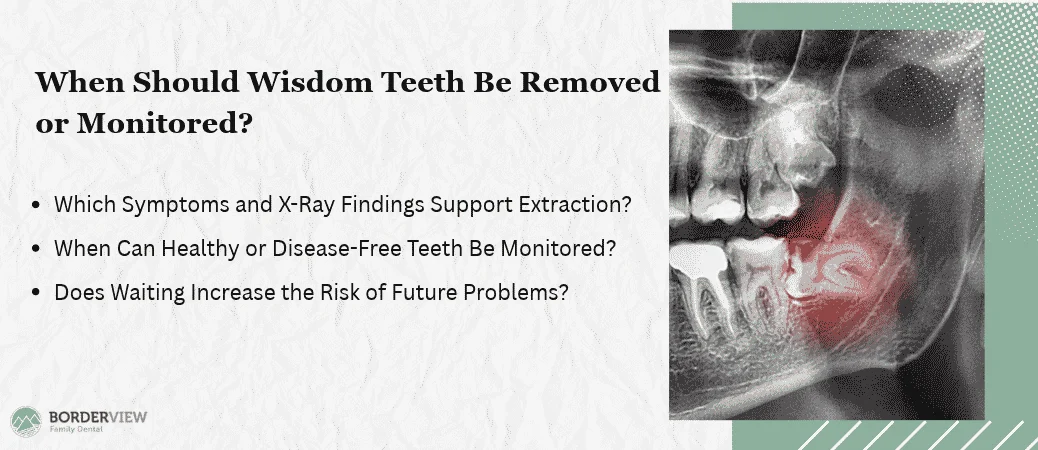
Which Symptoms and X-Ray Findings Support Extraction?
Your dentist will look for repeated pain, infection, decay that cannot be repaired, and damage to a nearby tooth. A partially erupted tooth also needs evaluation for pericoronitis, which means inflamed gum tissue around the tooth.
You might notice sore gums, a bad taste, or trouble opening your mouth during a flare-up. Your X-rays help reveal hidden problems, including bone loss or a cyst around impacted wisdom teeth.
Impaction alone needs assessment; the finding does not settle every removal decision.
When Can Healthy or Disease-Free Teeth Be Monitored?
You have a stronger case for keeping wisdom teeth when they have grown in fully, bite properly, and are easy to clean. You also need healthy gums and no evidence of damage to neighboring teeth.
For disease-free impacted teeth, ask about the benefits and risks of observation.
At Borderview Family Dental, routine dental exams and cleanings provide an opportunity to monitor your wisdom teeth and surrounding gum health.
Your dentist can explain which findings support removal and when additional imaging may be needed.
Does Waiting Increase the Risk of Future Problems?
Waiting leaves room for future decay or gum disease, especially when cleaning is difficult. You should continue monitoring retained wisdom teeth because problems sometimes develop later.
A lack of pain does not establish that your teeth are disease-free. Keep scheduled dental visits and report changes between appointments.
If your dentist identifies active damage, discuss how delaying treatment would affect that tooth and the molar beside it.
How Should Adults Prepare for Wisdom Tooth Extraction?
Prepare by confirming why each tooth needs removal and arranging support for your procedure and recovery. Your consultation should leave you with clear instructions about medications, food, transportation, and time away from work.
Should You See a General Dentist or an Oral Surgeon?
Your general dentist handles some straightforward tooth extractions, including accessible wisdom teeth. An oral surgeon brings specialty training for deeply impacted teeth, complex anatomy, and certain sedation needs.
Ask who will perform your wisdom tooth extraction and why that setting fits your case. A referral is especially useful when your roots are close to a nerve or your medical needs require added support.
Confirm whom you should contact if a problem develops after office hours.
How Do Imaging, Medications, and Medical History Shape the Plan?
Your dental X-rays show root shape, tooth angle, and nearby structures. If your lower roots appear close to the inferior alveolar nerve, which supplies feeling to your lower lip and chin, your surgeon will assess that relationship carefully.
You might need a three-dimensional scan if it would change the treatment plan. For selected lower teeth with high nerve risk, ask whether a coronectomy is appropriate. With this approach, your surgeon removes the crown and leaves the roots.
Bring a complete medication list, including supplements. Tell your provider about blood thinners, osteoporosis medicines, allergies, sleep apnea, and past anesthesia problems.
Keep taking prescribed medicines unless your treating clinicians give you a specific change.
Which Anesthesia Options Are Available?
Your anesthesia plan should match the procedure and your health needs. Local anesthesia numbs the area while you remain awake; you should expect pressure or movement, and you should speak up if you feel sharp pain.
With IV sedation, you receive medication through a vein to help you relax, along with local numbing.
General anesthesia keeps you unconscious and requires closer monitoring. Your provider will explain which options are suitable for you.
If fear has delayed treatment, discuss sedation dentistry during your consultation. Ask for written fasting instructions and arrange an adult escort when required.
If you receive IV sedation or general anesthesia, arrange for a responsible adult to accompany you home and follow your clinician’s instructions about driving, work, and other activities.
Restrictions depend on the medications and type of anesthesia used.
What Happens During Extraction, and What Affects the Cost?
Once your mouth is numb, your clinician loosens and removes the tooth. For an impacted tooth, your procedure might include a gum incision, removal of some overlying bone, or dividing the tooth into smaller pieces.
Your clinician then cleans the area and places stitches if needed. Gauze helps control bleeding while a protective clot forms in the socket.
The cost of wisdom tooth removal depends on the number of teeth being extracted, surgical complexity, imaging, and anesthesia.
When planning for affordable tooth extractions, request an itemized estimate and ask which services and follow-up visits are included.
What Should You Expect During Recovery?
Your wisdom teeth removal recovery includes an early period of soreness followed by a gradual return to normal activity. Feeling ready for work comes before the socket and underlying bone finish healing.

Days 1–3: Bleeding, Swelling, and Jaw Stiffness
During your first day, light oozing or blood-tinged saliva is expected. Follow your clinician’s instructions for firm gauze pressure, and rest with your head raised.
Your swelling after wisdom teeth removal and jaw stiffness often increase before they begin to settle. Use a wrapped cold pack as directed, and take pain medicine on the recommended schedule. Check that any over-the-counter medicine is safe with your health conditions and other prescriptions.
You should still be able to swallow fluids and breathe comfortably. Rapidly spreading swelling or uncontrolled bleeding needs prompt attention.
Days 4–14 and Beyond: Returning to Work, Food, and Exercise
As your symptoms ease, gradually return to normal meals and daily tasks. Your recovery from a straightforward extraction is often quicker than recovery from several deeply impacted teeth.
You should arrange flexible time off if your job involves lifting, constant talking, or physical effort.
Your gum opening continues to close after you feel functional, and bone healing takes longer.
Keep food away from tender sockets, use any cleaning syringe only as instructed, and wait for clearance before strenuous exercise if your surgeon has restricted it.
How Can You Protect the Blood Clot and Support Healing?
You protect the clot by limiting suction and keeping the area clean without disturbing it. During the first 24 hours, avoid straws, forceful rinsing, and spitting.
Follow your own discharge instructions for brushing and gentle rinsing afterward. Choose soft foods such as eggs or mashed potatoes, drink enough water, and keep hard or crunchy foods away from the wounds.
If fear of surgery has delayed your decision, learning about dental care options for dental phobia can help you prepare questions about comfort, anesthesia, and what to expect during treatment.
Which Symptoms Need a Dental Call or Emergency Care?
Call your dentist or surgeon if your pain becomes stronger after it had started improving. Dry socket causes deep pain when the protective clot is lost or breaks down; your dental team needs to assess and treat it.
You also need a dental call for fever, pus, swelling that worsens after initial improvement, or numbness that persists beyond the expected anesthetic effect.
If prescribed medicine is failing to control your discomfort, seek treatment for severe tooth pain promptly.
Seek emergency care for trouble breathing or swallowing, rapidly spreading swelling, or heavy bleeding that continues despite firm pressure.
Follow your discharge instructions for contacting your surgical team, and call 911 for a breathing emergency.
Choose Timing Based on Tooth Health, Not Age Alone

The best time for wisdom tooth removal depends on your oral health, tooth position, and individual risks rather than a specific birthday.
Although some extractions may be less complicated earlier in adulthood, healthy wisdom teeth do not always require removal.
If removal is recommended, ask what problem the treatment is intended to address and how much recovery support you may need. If you keep your teeth, leave with a follow-up plan that protects your oral health and checks the nearby molars.
Frequently Asked Questions
You can plan wisdom teeth removal for adults at any of these ages with an individualized assessment. These answers address common concerns about timing and recovery.
Is 25 too old to remove wisdom teeth?
You are not too old to have wisdom teeth removed at 25. Your X-rays show root development and surgical difficulty more clearly than your birthday does.
Is it a good idea to remove wisdom teeth in your 30s?
You have a good reason to consider removal in your 30s if your teeth have repeated infections, untreated decay, or damage to nearby structures.
If your teeth are disease-free, discuss monitoring and the risks of elective surgery before deciding.
Is it safe to remove wisdom teeth in my 40s?
You can undergo wisdom tooth removal in your 40s after an appropriate medical and dental assessment. Ask your clinician to explain your individual risks, especially nerve injury, bleeding, and delayed healing.
Will recovery take longer at 40 than at 20?
You might need longer to recover at 40, especially after a difficult extraction or if you have a condition that affects healing. Your wisdom teeth removal recovery estimate should account for surgical complexity, medications, and tobacco use.
What should I know before having wisdom teeth removed as an adult?
You should know why each tooth needs removal, who will perform the procedure, and which anesthesia you will receive. Before surgery, confirm your medication instructions, total estimated cost, ride home, and after-hours contact number.


